
If you have ever looked at a set of architectural drawings and felt overwhelmed by the lines, symbols, and annotations, you are not alone. For most property owners, dealing with architectural drawings is an unfamiliar experience. Understanding what each drawing type means and why it is needed puts you in a much stronger position when working with designers, builders, and council.
Why a 'Complete Set' Matters
A complete set of architectural drawings gives every party involved in your project — the council, the building surveyor, the engineer, and the builder — a clear and consistent picture of exactly what is being built. Incomplete or inconsistent drawing sets are one of the leading causes of permit delays and on-site construction errors.
Different parties need different drawings for different reasons. Understanding what is included helps you ask the right questions and ensures nothing critical is missing.
The Core Drawing Types Explained
Site Plan
The site plan shows your entire block from above, including the location of the proposed building (or extension) relative to property boundaries, neighbouring structures, easements, and site features such as trees and driveways.
The site plan is one of the first documents a council planner will review — it allows them to check setbacks, site coverage, and whether the proposal complies with the relevant planning scheme.
Floor Plans
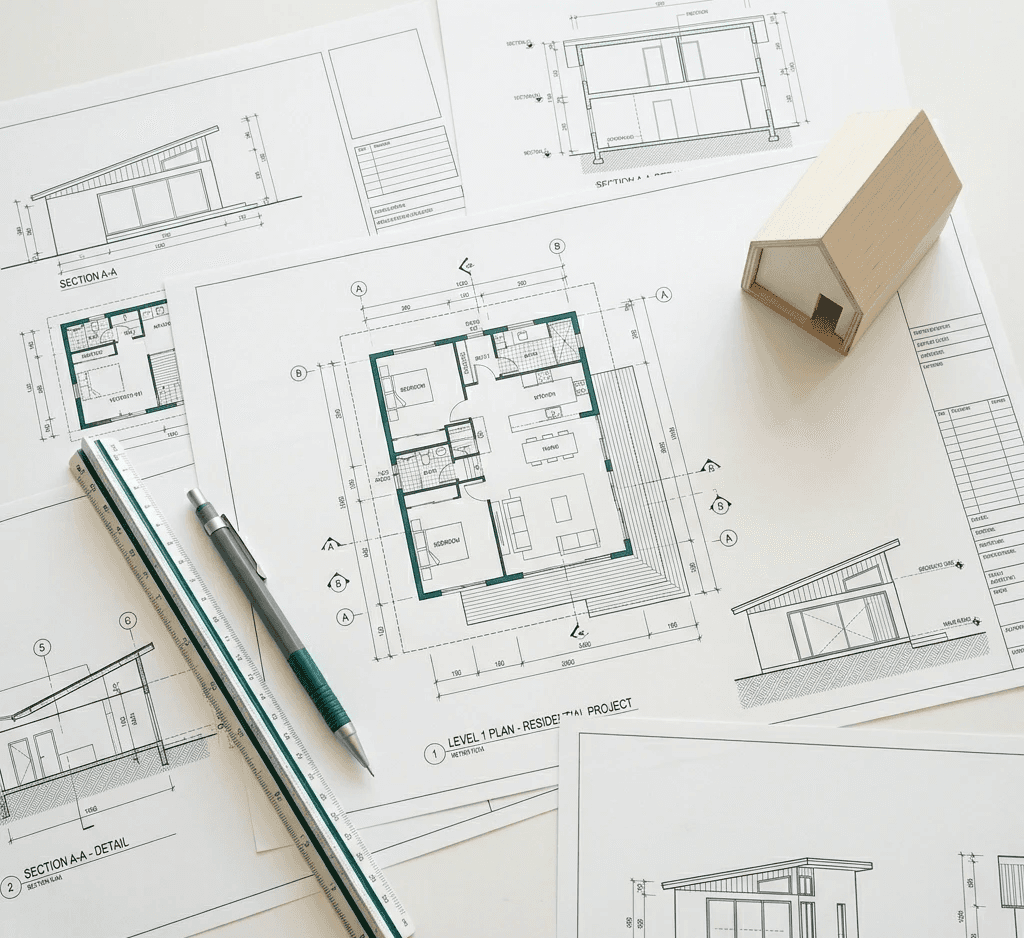
Floor plans are a horizontal cross-section view of each level of the building, showing the layout of all rooms, walls, openings (doors and windows), staircases, and key dimensions.
They are used by builders to understand the spatial arrangement and by engineers to identify load paths. Floor plans are required for every level of a multi-storey building.
Elevations
Elevations show the external face of the building as seen straight-on from each side — typically north, south, east, and west. They depict the roof form, window and door positions, materials, and external finishes.
Elevations are critical for assessing how the building will look in the streetscape and for checking height compliance.
Sections
A section drawing cuts through the building vertically to reveal internal heights, ceiling configurations, staircase geometry, and structural relationships between elements.
They are particularly important for split-level homes, buildings with complex roof forms, and any project involving significant changes to floor or ceiling heights.
Roof Plan
The roof plan shows the building from above, detailing the roof geometry, ridgelines, valleys, guttering, and fall directions. It is used by both the building surveyor and the builder.
Detail Drawings
Detail drawings zoom in on specific junctions or elements — such as how a window is flashed and sealed, how a deck connects to the main structure, or how a staircase handrail is fixed. They are particularly important for complex or unusual construction details where a standard approach is not sufficient.
What QuikDraft Includes in Every Drawing Set
At QuikDraft, every residential drawing set is prepared to include all documents required for your specific permit pathway. We clearly label each drawing, use consistent scales and annotations, and ensure all dimensions are coordinated across the full set.
We take the guesswork out of what needs to be submitted — so your application is complete the first time.


