
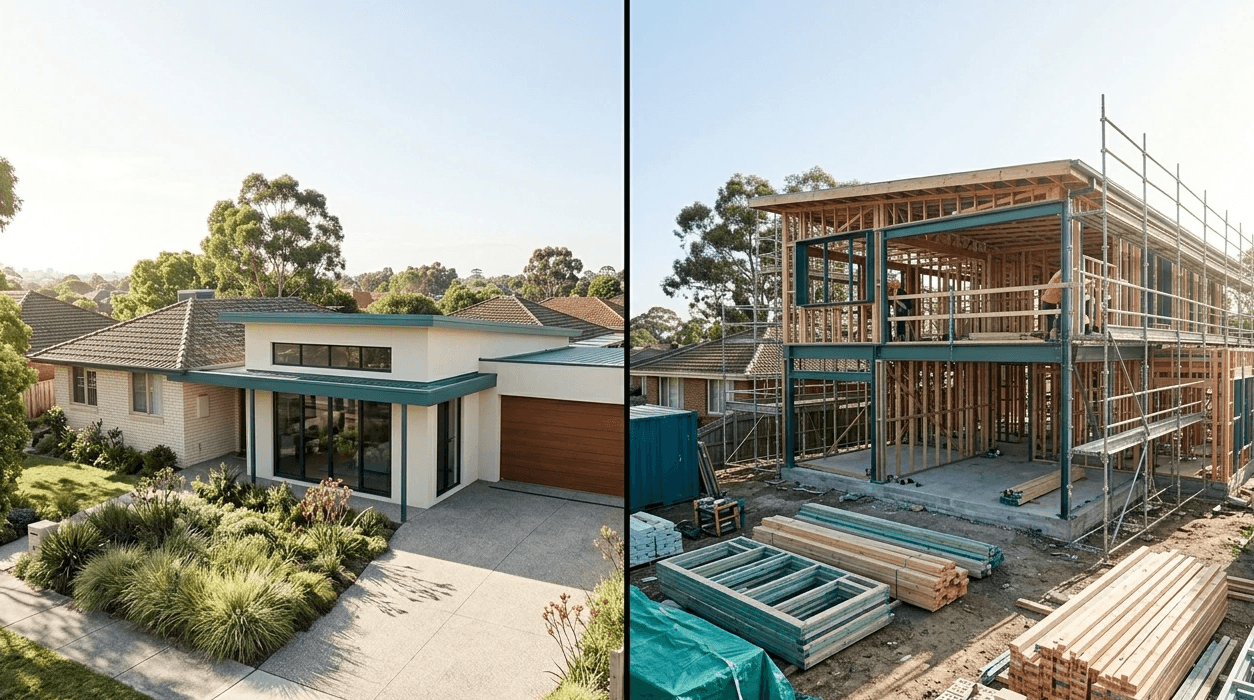
Your family has outgrown your home. Maybe you need an extra bedroom, a larger living area, or an entirely new layout. The big question facing many Australian property owners is whether to extend what they already have or demolish and start from scratch. Both paths have merit — and the right choice depends on several factors unique to your situation.
The Case for a Home Extension
Extending your existing home can be a cost-effective way to add space without the upheaval of a full rebuild. It allows you to retain the existing structure, which can significantly reduce costs, and it typically involves a shorter construction timeline than a new build.
Extensions are particularly well-suited to properties where the existing home is structurally sound and the layout works well — you simply need more of it. Ground-floor extensions (rear or side), upper-storey additions, and garage conversions are all popular options.
Generally lower cost than a full rebuild
Shorter construction timeframe in most cases
Preserves existing infrastructure (plumbing, electrical, roof lines)
Can be staged over time to manage budget
Often preferred on heritage-listed or character properties
The Case for a Knockdown Rebuild
A knockdown rebuild involves demolishing the existing structure and building a completely new home on your existing land. This option is increasingly popular, particularly in established suburbs where land values are high and quality blocks are scarce.
If your existing home is in poor condition, has significant structural issues, or the floor plan is fundamentally unsuited to your needs, rebuilding may ultimately be more cost-efficient — and will certainly deliver a more modern, energy-efficient outcome.
Complete design freedom — no constraints from the existing structure
Opportunity to maximise the lot fully within planning rules
Modern energy efficiency, insulation, and materials throughout
New home warranty and compliance from day one
Can better suit maximising property value in premium locations
Key Factors to Consider
Condition of the existing structure — major structural issues can make extension costs prohibitive
Planning overlays and heritage controls — some properties have restrictions on demolition
Council zoning — determines how much of your block can be built on
Budget — get preliminary estimates for both options before deciding
Timeline — new builds typically take 12–18 months; extensions can vary from 3–12 months
Disruption — will you need to vacate? For how long?
What Architectural Drawings Are Needed for Each Path?
Both extensions and new builds require formal architectural drawings for permit applications. For an extension, drawings must show how the new work integrates with the existing structure. For a new build, a full set of construction drawings is required from scratch.
QuikDraft prepares drawings for both scenarios — and can help you understand the scope of documentation required before you commit to either path.


