
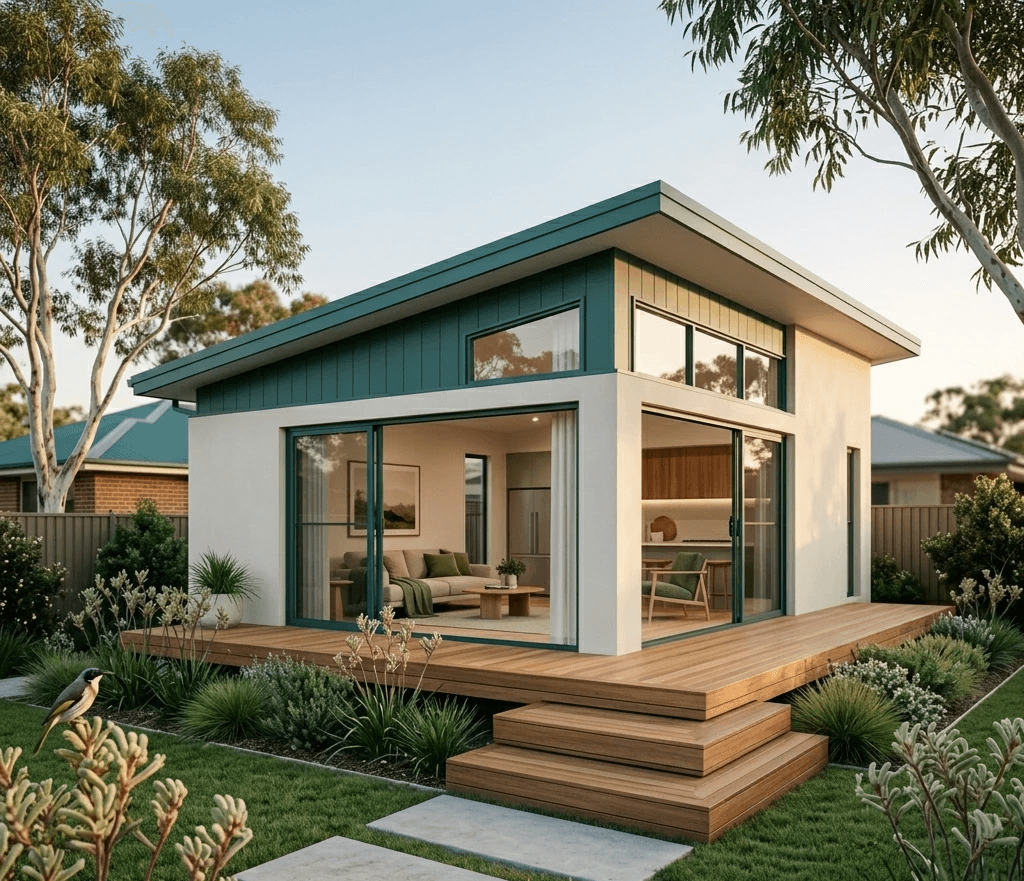
Secondary dwellings — commonly known as granny flats — have surged in popularity across Australia. Whether you are looking to house an aging parent, generate rental income, or create a private space for a young adult child, a well-designed secondary dwelling can add significant value and flexibility to your property.
What Is a Secondary Dwelling?
A secondary dwelling is a self-contained residential unit located on the same lot as a principal dwelling. It typically includes its own kitchen, bathroom, bedroom, and living area. Depending on your state, it may be referred to as a secondary dwelling, ancillary dwelling, granny flat, or studio.
Secondary dwellings can be attached to the main home, detached within the backyard, or in some cases a converted garage or outbuilding.
Can You Build One on Your Property?
Whether a secondary dwelling is permissible on your property depends on your council’s local planning scheme, your block size, and applicable provisions under the Victorian Planning Provisions (VPP) and any relevant residential zone requirements.
In Victoria, secondary dwellings (known as “dependent person’s units” in some zones, or more commonly approved as a second dwelling on a lot) are generally assessed under the Residential Growth Zone, General Residential Zone, or Neighbourhood Residential Zone provisions of your council’s planning scheme. In many cases, a planning permit is required, though some councils and zones allow a second dwelling as-of-right subject to specific conditions such as minimum lot size and maximum floor area.
Minimum lot size requirements (varies by zone and council; typically 300m²–500m² in Victorian residential zones)
Maximum floor area limits (often 60m²–80m² depending on zone and council planning scheme provisions)
Setback requirements from boundaries and the main dwelling
Height restrictions
On-site parking requirements
Separate utility connections may or may not be required
Planning Permit vs. As-of-Right Development
In Victoria, secondary dwellings may be approved as-of-right (without a planning permit) in certain zones where the proposal meets all the requirements set out in the planning scheme — such as site coverage, setbacks, and height limits. Where these requirements are met, a building permit alone may be sufficient to proceed.
If your property or project does not meet as-of-right requirements, you will need to apply for a planning permit through your local council. This involves a more detailed assessment process — including neighbour notification in many cases — and can take anywhere from 60 days to several months depending on the council and complexity of the application. A planning permit, if granted, sets out conditions your project must meet, after which a separate building permit is still required before construction can commence.
What Drawings Are Required?
Regardless of which approval pathway applies, professional architectural drawings are required. A typical secondary dwelling drawing set includes:
Site plan showing the location of both dwellings on the lot
Floor plans showing room layout and dimensions
Elevations showing external appearance from all sides
Section drawings showing internal heights and structural detail
Shadow diagrams (often required for DA applications)
NatHERS energy efficiency report (minimum 7-star rating required under the NCC for new dwellings in Victoria)
QuikDraft specialises in secondary dwelling drawings and is familiar with planning permit and building permit requirements across Victorian councils. Our drawings are prepared to meet the specific submission requirements of your approval pathway.


